Table of contents
Chapter 1: What is lowbed trailer?
1.1 What is the standard size of low bed trailer?
1.2 What is the load capacity of low bed trailer?
Chapter 2: What is a lowbed used for?
Chapter 3: What's the difference between flatbed and lowbed?
A lowbed trailer is a type of heavy-duty trailer used for transporting oversized and overweight loads. It is specifically designed to carry tall and heavy equipment such as construction machinery, industrial equipment, and vehicles that cannot be transported on a standard flatbed trailer due to their height or weight.
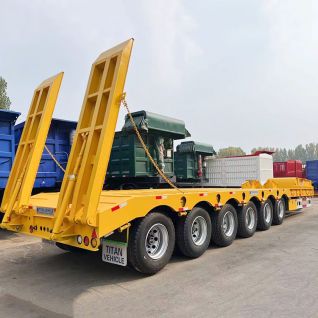
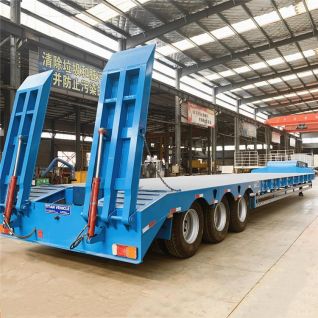
Lowbed trailer in Zambia has a very low deck height and an inclined ramp at the back for easy loading and unloading of the cargo. The deck is typically positioned close to the ground to accommodate tall equipment and provide stability during transport. Lowbed trailer usually have multiple axles to distribute the weight evenly and improve load-bearing capacity.
It has a lower deck height than a standard flatbed trailer, allowing it to carry taller loads while maintaining proper clearance on the road. The low design helps keep the center of gravity low which increases stability during transportation, making the process safer and more efficient.
These trailers are widely used in industries such as construction, mining, and oil and gas, where heavy equipment needs to be transported to different job sites. The lowbed trailer ensures that the cargo remains stable, secure, and within legal height and weight limits during transportation.
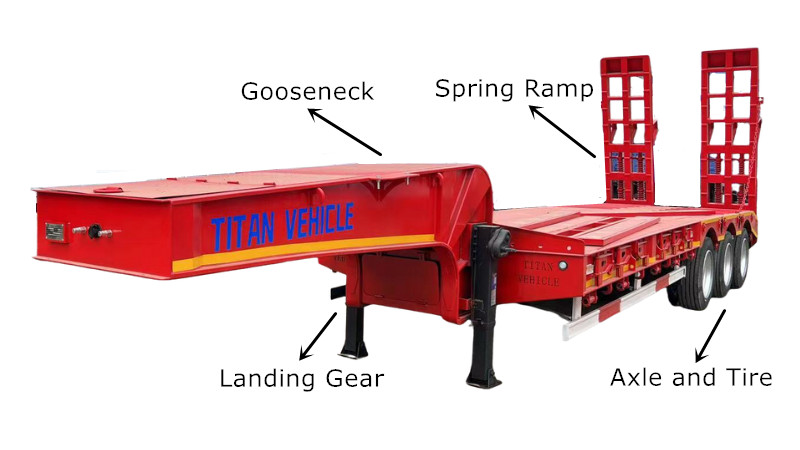
The standard size of a lowbed trailer can vary depending on the country and specific regulations. However, there are some general common dimensions for lowbed trailers.
In terms of length, lowbed trailers typically range from 40 to 53 feet (12 to 16 meters). The length may vary based on the number of axles and the specific weight distribution requirements for the loads being transported.
Regarding width, most lowbed trailers have a standard width of around 8.5 feet (2.6 meters). This allows for compatibility with road regulations and ensures that the trailer can maneuver safely within traffic lanes.
As a professional manufacturer, we has provided many lowbed trailers for many countries. Lowbed trailers have different capacities, we can customize the lowbed trailer for you according to your needs.
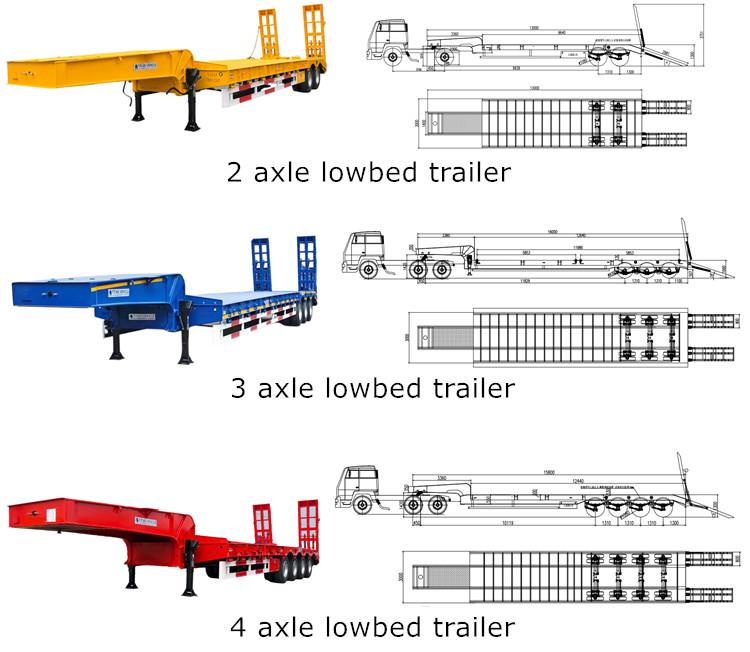
The following are the dimensions of several conventional models of lowbed trailer in Zambia:
2 axle lowbed trailer dimensions: 13000*3000*3750mm(platform height 1300mm)
3 axle lowbed trailer dimensions: 14000*3000*3400mm(platform height 950mm)
4 axle lowbed trailer dimensions: 15800*3000*3750mm(platform height 1300mm)
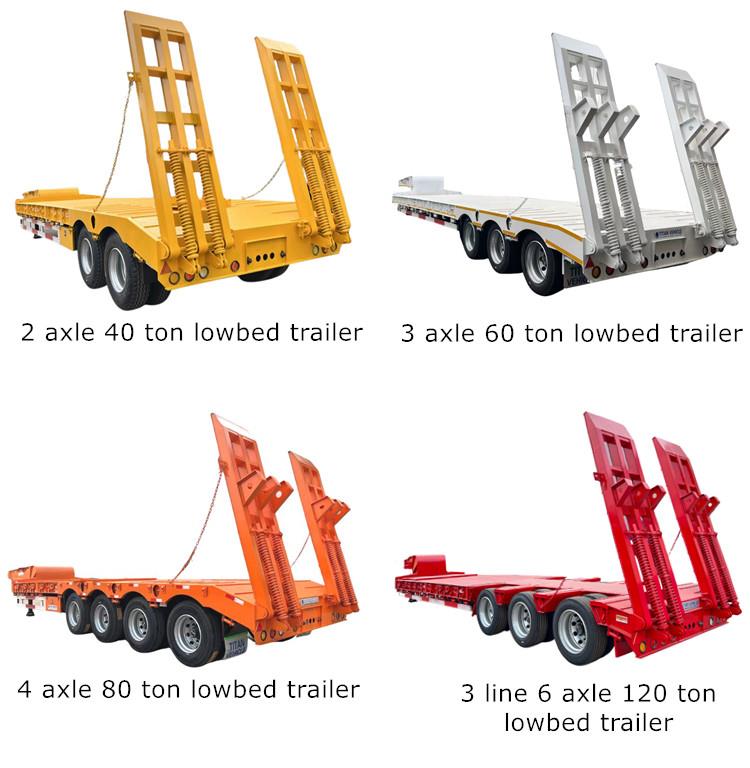
The load capacity of a lowbed trailer can vary depending on several factors, including its design, construction, axle configuration, and any regional regulations that may apply.
That being said, lowbed trailers are generally designed to transport heavy and oversized cargo, so they typically have higher load capacities compared to standard trailers. The load capacity of a lowbed trailer is mainly determined by two factors:
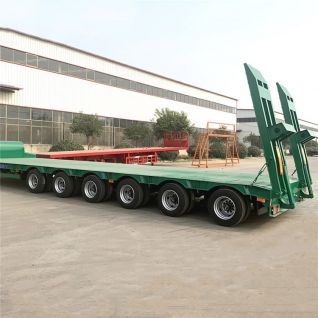
Axle Configuration: Lowbed trailer for sale in Zambia can have different axle configurations, such as 2-axle, 3-axle, or multi-axle setups. More axles generally increase the load-bearing capacity of the trailer. For example, a 2-axle lowbed trailer may have a lower load capacity compared to a 4-axle lowbed trailer.
Gross Vehicle Weight Rating (GVWR): The GVWR is the maximum allowable weight of the fully loaded trailer, including the weight of the trailer itself and the cargo. Low bed trailers with higher GVWR ratings are capable of carrying heavier loads.
We will be able to provide you with the most accurate and up-to-date information based on the specific model and configuration you are interested in.
A lowbed trailer is primarily used for transporting oversized and heavy equipment or machinery that cannot be accommodated on a standard flatbed trailer due to their height or weight. It is extensively utilized in various industries, including:
Construction: Lowbed trailers are commonly employed to transport construction equipment such as bulldozers, excavators, cranes, loaders, and other heavy machinery to construction sites.
Mining: In the mining industry, lowbed trailers are crucial for moving massive mining equipment, including giant trucks, drills, and excavators, between mining sites or to maintenance facilities.
Oil and Gas: Lowbed trailers are utilized in the oil and gas sector for transporting drilling rigs, oilfield equipment, pipeline machinery, and other heavy components involved in exploration, drilling, and production operations.
Agriculture: They are used in agriculture for transporting large farm machinery such as tractors, harvesters, and sprayers to different fields or farm locations.
Forestry: Lowbed trailers play a significant role in the forestry industry by transporting forestry equipment like log loaders, skidders, and forestry trucks to logging sites.
Infrastructure Projects: During infrastructure projects like bridge construction or road expansion, lowbed trailers are employed to transport heavy construction equipment, concrete beams, precast elements, and other oversized materials to the worksites.
Energy Sector: Lowbed trailers are involved in transporting large generators, turbines, transformers, and other heavy equipment required for power generation plants.
In summary, lowbed trailer in Zambia is specialized transportation equipment used across multiple industries to move heavy, tall, and oversized loads safely and efficiently to their destinations.
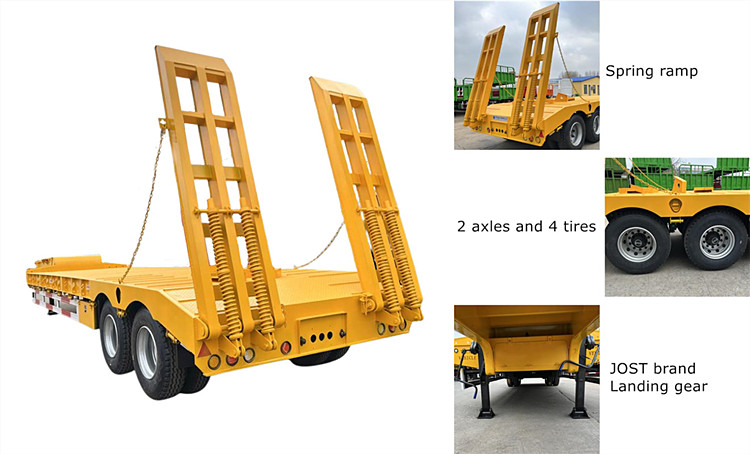
The main difference between a flatbed trailer and a lowbed trailer lies in their design and purpose. Here are the key distinctions:
1. Deck Height
A flatbed trailer has a higher deck height compared to a lowbed trailer. The deck of a flatbed trailer is positioned higher from the ground, the low deck height of the lowbed trailer allows for the transport of taller equipment.
2. Cargo Height and Clearance
Flatbed trailers typically have no limitations on cargo height. They are suitable for transporting standard-sized, stackable commodities, materials, or equipment. However, lowbed trailers are specifically designed to accommodate taller and oversized loads. Their low deck height ensures that taller equipment, machinery, or structures can be loaded onto the trailer, while still complying with height restrictions imposed by road regulations.
3. Load Capacity
Flatbed trailers generally have a higher load-carrying capacity compared to lowbed trailers. They are designed to carry evenly distributed weight across the entire deck. Flatbed trailers are often used for hauling bulk goods, palletized materials, or multiple smaller items. Conversely, lowbed trailers have a lower load capacity due to their specialized design and lower deck height. They are primarily employed for transporting heavy equipment, machinery, and oversized loads that require a lower deck for stability and proper weight distribution.
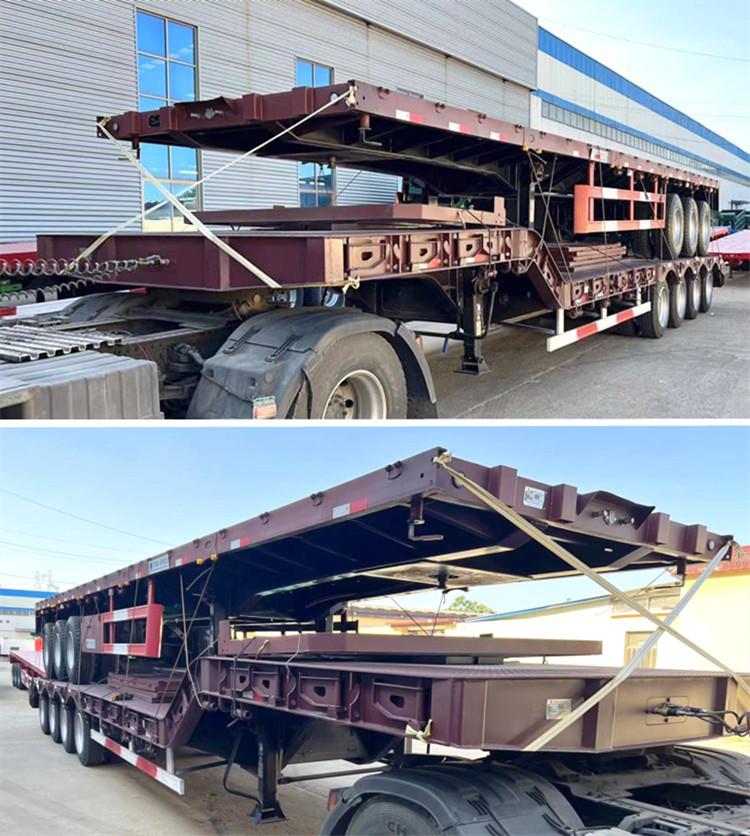
Tri Axle Flatbed Trailer and 4 Axle Lowbed Trailer will be sent to Zambia
4. Stability
Compared with flatbed trailer, 40ft low bed trailer for sale deck is excellent. A lower deck means a lower center of gravity. Therefore, 40ft low bed trailer is more stable than trailers when transporting heavy goods.
One way to increase stability is to expand the support base. For 40ft low bed trailer for sale, this is possible because the width of the cargo plane can be widened. Regardless of the height and weight of the cargo, the trailer can remain stable on the road.
5. Loading and Unloading
Both flatbed and lowbed trailers offer ease of loading and unloading, but the methods differ. Flatbed trailers allow for loading and unloading from all sides since their decks are at an accessible height. Lowbed trailers typically have a rear loading ramp (inclined or hydraulic) to facilitate the loading and unloading of heavy equipment. The ramp is positioned at the back end of the lowbed trailer, allowing the equipment to be driven or moved onto the deck.
In summary, while both flatbed and lowbed trailers are used for transportation, flatbed trailers are more versatile for standard-sized loads, while lowbed trailers are specialized for transporting taller, heavier, and oversized equipment or machinery.
1. What cargo can be transported by a lowbed trailer?
Lowbed trailers are mainly used for transporting heavy and oversized equipment, including:
Excavators
Bulldozers
Wheel loaders
Cranes
Mining machinery
Agricultural machines
Road construction equipment
Industrial equipment
Steel structures
Large engineering components
2. What is the loading capacity of a lowbed trailer?
The loading capacity of a lowbed trailer depends on the axle number, frame design, suspension system, and local transportation regulations.
Common capacities include:
3 axle lowbed trailer: about 40–60 tons
4 axle lowbed trailer: about 60–100 tons
5 axle lowbed trailer: about 80–120 tons
Multi axle lowbed trailer: 150 tons or more
3. Can lowbed trailers be customized?
Yes. Lowbed trailers can be customized according to different transportation requirements, including:
Number of axles
Loading capacity
Platform length and width
Ramp design
Hydraulic suspension
Mechanical suspension
Detachable gooseneck
Folding gooseneck
Extendable platform
Different axle brands
Customization allows customers to choose the best trailer solution according to cargo type and road conditions.
4. Why choose a lowbed trailer for heavy equipment transportation?
A lowbed trailer provides a safer and more efficient solution for heavy equipment transportation. Its low platform design, strong frame structure, and flexible configurations make it suitable for demanding transportation conditions.
For construction companies, mining companies, and logistics providers, investing in a reliable lowbed trailer allows them to transport larger equipment, improve project efficiency, and expand their heavy haul transportation business.